

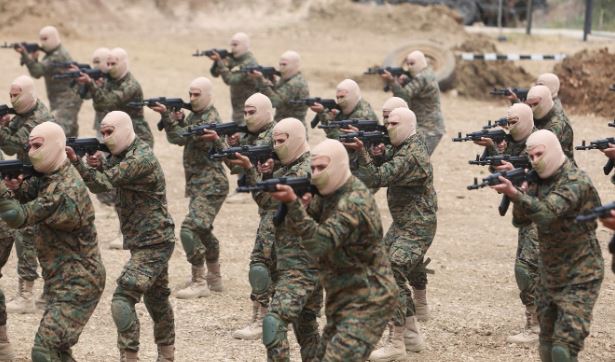
A recent report by Colombian investigative journalist Yohir Akerman has revealed that the pro-Iran Islamic militant group Hezbollah is part of a complex transnational criminal network operating on the Colombia-Venezuela border. The network, which is backed by the Venezuelan state, involves dissidents from the Revolutionary Armed Forces of Colombia (FARC), the Colombian National Liberation Army (ELN) rebel group, and Venezuela’s Cartel of the Suns, a Venezuelan military-linked cartel recently designated as a “terrorist group” by US authorities.
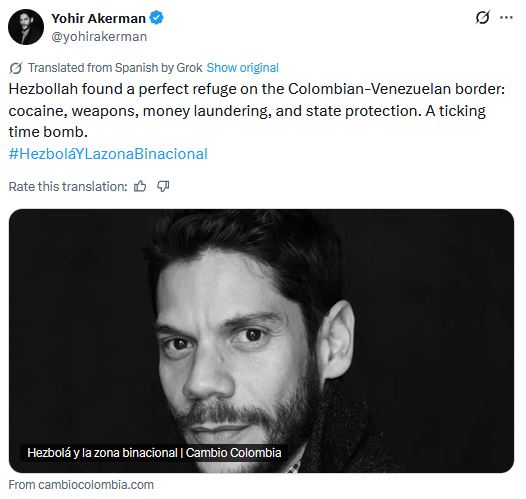
According to Akerman’s report, published in Colombian liberal news magazine Cambio, the alliance is a “documented mechanism” that combines terrorism, drug trafficking, and money laundering with state protection. The network operates as a “well-oiled system” with channels that move through Dubai, Venezuela, Colombia, the Caribbean, and into global financial circuits. The Colombia-Venezuela border is the hub of the operation, with cocaine routes, cash flows, and clandestine intelligence operations converging in the region.
The report cites a confidential US intelligence memorandum dated May 25, which was drawn up by the US State Department’s Bureau of Western Hemisphere Affairs. The memorandum describes how the ELN and FARC rebels provide infrastructure within Colombian territory, including control of border crossings, storage camps, and armed personnel securing the various routes. In exchange, they receive weapons, cash, and logistical support from the network backed by Hezbollah and the Cartel of the Suns.
Hezbollah is said to play a “dual role” in the network, offering expertise in money laundering through Dubai, Doha, Tehran, and other Middle Eastern financial hubs, as well as training local combatants in counterinsurgency techniques, handling explosives, drone usage, and encrypted communications. The Venezuelan state is essential to the operation, with military generals linked to the Cartel of the Suns providing safe-conduct passes, access to official airports, and armed escorts, giving the operations a veneer of “legality”.

The report comes amid heightened regional tensions, following US accusations that Venezuelan leader Nicolas Maduro is leading the Cartel of the Suns. The Maduro government has denied the allegations, claiming that the US is seeking a pretext for military intervention.
Akerman’s report highlights the dangers of a “bilateral zone” between Colombia and Venezuela, which could become a “legal corridor that strengthens Hezbollah’s networks” and formalize “the first enclave of transnational crime in Latin America”. He notes that Hezbollah is no longer acting through isolated cells, but is a hybrid organization that operates as a “terrorist” group, a political party, an armed militia, and a criminal organization.
Increase in terrorist activity
Reports of Hezbollah assisting groups such as FARC will be of particular concern following the explosion of a lorry laden with explosives near a military base in Cali, Valle de Cauca which killed six and wounded many more. A second explosives filled lorry failed to detonate according to local media. On the same day, a Blackhawk helicopter carrying out coca eradication flights, was brought down by a drone in Amalfi, Antioquia, killing at least 12 police officers. Leftist President Gustavo Petro said that the insurgents were acting on orders from a drug cartel allegedly based in Dubai, the so-called “Junta del Narcotrafico”. Colombian security forces said that they believed the attacks had been carried out by members of two separate dissident rebel factions from the mostly-demobilised Revolutionary Armed Forces of Colombia (FARC).
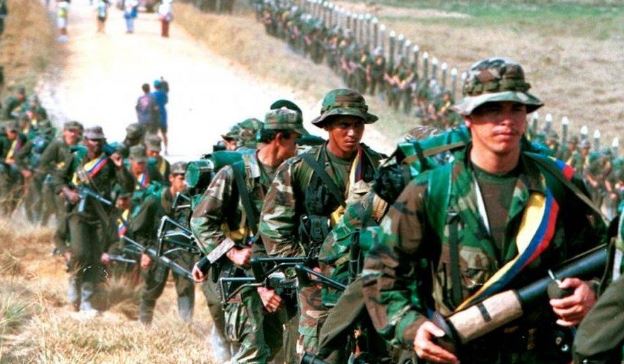
On the one hand, the truck bomb in Cali was attributed to members of the Central General Staff (EMC), a group commanded by alias Iván Mordisco. The 36th Front, part of the General Staff of Blocks and Fronts (EMBF), another dissident group led by alias Calarcá, was blamed for the downing of the helicopter with police on board in Amalfi, Antioquia. No armed group has claimed responsibility for the attacks.
In the past, the EMC and the EMBF formed a single structure, but they split in April 2024. Since then, the government has directly confronted the EMC, while maintaining a ceasefire with the EMBF until April of this year and is at the negotiating table as part of its “total peace” policy.
After learning of the attacks, Petro called for Iván Mordisco’s dissidents—that is, the EMC—to be considered terrorists “and persecuted anywhere on the planet.” The same was not done with the Calarcá dissidents (the EMBF), with whom the national government also met this Friday in the municipality of San Vicente del Caguán, Caquetá. The EMBF was accused of shooting down a helicopter that killed 13 police officers in Antioquia.
The Evolution of Dissident Movements
Months before the agreement between the guerrillas and the government was signed in 2016, the FARC’s First Front, composed of some 400 members and commanded by alias Iván Mordisco, announced that it would not demobilize. That was the seed of dissident movements.
At that time, the FARC leadership sent alias Gentil Duarte, who had been in the guerrilla for almost 40 years and was participating in the negotiations, to re-establish discipline on that front; that is, to align it with the rest of the FARC in the decision to lay down their weapons. But Duarte ended up abandoning the peace process as well, joining Mordisco and leading his people in the project of forming a dissident group.
Since then, dissident groups began to expand and consolidate, nourished by former FARC combatants, former members of other armed groups, and new recruits. Mordisco and Duarte managed to build a nationwide network that they later named the Central General Staff, “although, rather than a unified command, there was almost total co-governance and autonomy at the regional and local levels,” according to research by the Ideas for Peace Foundation.
According to the same research, “the growth and strengthening of the EMC is closely linked to the financial resources of economies such as drug trafficking, extortion, and illegal mining.”
This demonstrates the ongoing links between terrorist groups and drug cartels in Colombia. Throwing the influence of Hezbollah into the mix highlights the complex nature of the terrorist threat in Colombia.