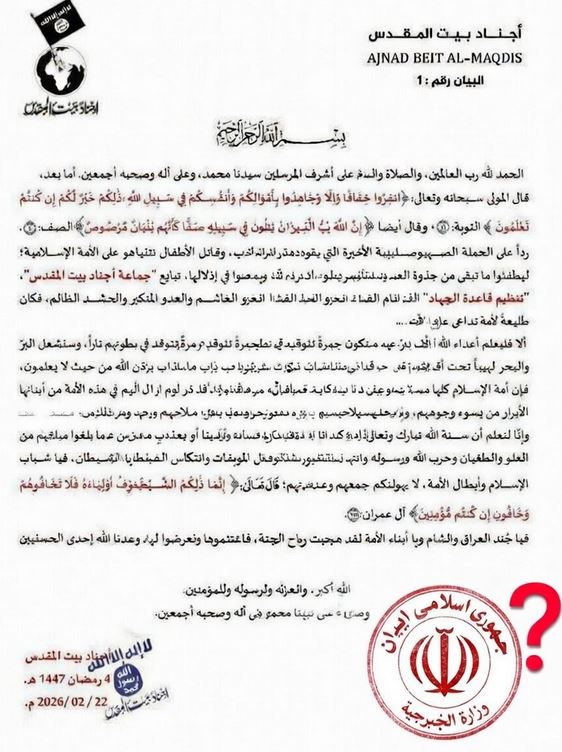

A newly formed jihadist group, Ajnad Beit al-Maqdis (Soldiers of Jerusalem), has announced its allegiance to al-Qaeda. The group emerged from obscurity with a statement dated March 1, asserting it had targeted U.S. forces in Shaddadi, Hasaka province, using 107mm Katyusha rockets. The claim, circulated by Islamists and security analysts on March 2–3, lacked details on casualties and raised more questions than answers.
The group, which claims to operate in Syria and Iraq, has vowed to target U.S. and Israeli interests in response to what it calls a “Zionist-Crusader campaign” led by President Trump. However, its credibility and operational presence remain shrouded in doubt, with critics alleging it may be an Iranian proxy.
Pledge of loyalty
In its inaugural statement, dated February 22 but released on March 1, Ajnad Beit al-Maqdis framed its formation as a direct response to al-Qaeda’s February 4 mobilization call, urging Muslims to attack U.S. military bases and interests in the Middle East. The group’s rhetoric echoed al-Qaeda’s warnings of a renewed “Crusader-Zionist” campaign under Trump, accusing him and Israeli Prime Minister Netanyahu of seeking to “extinguish” Muslim states.
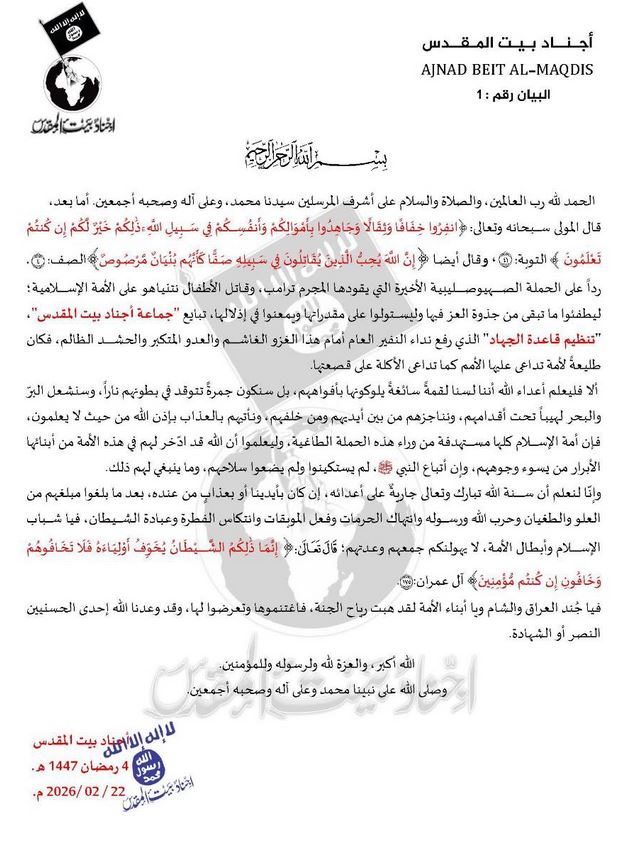
Despite its fiery rhetoric, the group has no verified media outlet, and its statements have been disseminated via third-party platforms like Telegram, X, and RocketChat. Self-described journalist Hamid al-Qawsi, known for amplifying pro-al-Qaeda content, was among the first to share the group’s founding statement, speculating it was based in Iraq—a claim not supported by the group itself.
Attack Claim Disputed
Regional media widely reported an attack on the Shaddadi base on March 1, but conflicting accounts emerged. Some sources claimed U.S. forces had already evacuated the facility, while others suggested the targeted camp was empty—a detail exploited by critics to mock the group’s assertion.
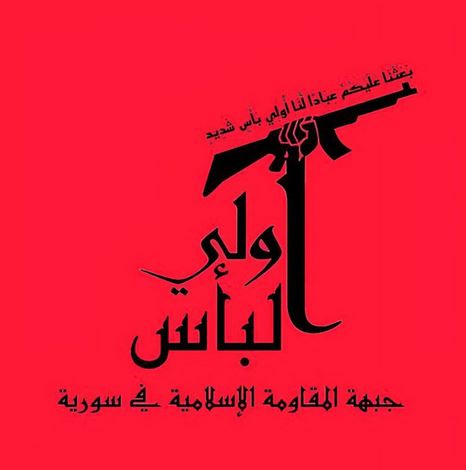
Adding to the confusion, another obscure Syrian militant group, Uli al-Bas (Islamic Resistance Front in Syria), suspected of Iranian sympathies, separately claimed responsibility for the same attack via its Telegram channel. The overlapping claims prompted speculation about potential coordination or an Iranian link, particularly given accusations by the Islamic State group (IS) that al-Qaeda is tacitly aligned with Tehran.
IS and Islamist Reactions
The Islamic State (IS) and its supporters swiftly dismissed Ajnad Beit al-Maqdis as an Iranian front, accusing al-Qaeda of tacitly aligning with Tehran. IS-linked figures, such as Ikrimah al-Waeli, mocked the group as an “electronic stall” with no physical presence, while others highlighted similarities between its branding and Shia militia aesthetics. Anti-IS Islamist commentator Abu Yahya al-Shami echoed these suspicions, urging caution and noting the Shaddadi base’s reported vacancy.
Al-Qaeda Loyalists Divided
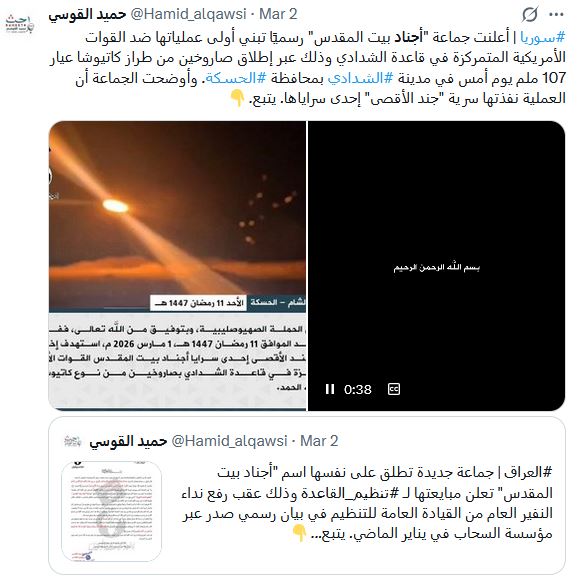
Pro-al-Qaeda journalist Hamid al-Qawsi amplified Ajnad Beit al-Maqdis’s claim, sharing a 41-second video purporting to show nighttime rocket launches. The clip, set to an Islamic chant, included text from the group’s statement but offered no verifiable details. Al-Qawsi further cited an unnamed “exclusive source” claiming the group comprises fighters from multiple Arab nations, though this assertion has not been independently confirmed.
Some supporters celebrated the group’s pledge, hoping for a revival of al-Qaeda’s influence in Iraq reminiscent of the late Abu Musab al-Zarqawi. Others, like alleged former AQAP member Riyad al-Asiri, dismissed the group as “fabricated.” Security analysts speculated ties to Hurras al-Din, al-Qaeda’s dissolved Syrian affiliate, while others hinted at Iranian infiltration.
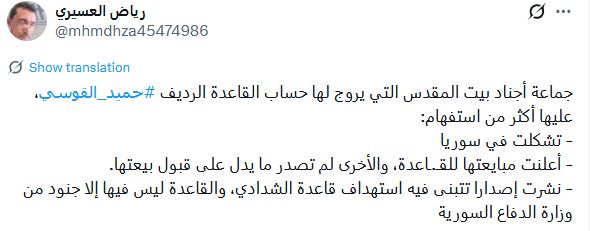
Skeptics argue the group may be a hastily assembled front for Iran-backed operations, leveraging al-Qaeda’s name to muddy geopolitical waters. Even within pro-al-Qaeda circles, uncertainty reigns: one user in a RocketChat group questioned the claim’s authenticity, noting Uli al-Bas’s rival assertion and labeling it a “Shia” group.
Within pro-al-Qaeda circles, reactions were mixed
Lingering Questions
Ajnad Beit al-Maqdis’s emergence comes amid escalating U.S.-Iran tensions and IS accusations that al-Qaeda is enabling Tehran’s agenda. With no confirmed operations, a disputed attack claim, and rival assertions from Uli al-Bas, the group’s legitimacy remains unproven. As Islamist and jihadist factions trade accusations, the episode underscores the fractious, opaque nature of militant networks in Syria—where allegiances shift as swiftly as the battle lines.