

A former high-ranking member of al-Qaeda in the Arabian Peninsula (AQAP) has launched a strong attack on the terrorist group’s leadership, accusing them nepotism, human rights abuses and a failure to adapt to the changing political landscape in Yemen.
Riyad al-Asiri, who claims to have held a senior position within AQAP, took to social media to air his grievances against the group, using the handles @naseh_ami on X and Telegram. In a series of articles published between July 12 and 28, al-Asiri accused AQAP of prioritizing its interests of its leaders over those of its members and the Yemeni people.

Al-Asiri’s criticism is significant, coming from a figure with insider knowledge of the group’s inner workings. He accused AQAP’s justice system of secrecy and its security apparatus of wielding excessive power and lacking accountability, alleging that the group has a culture of torture and mistreatment of detainees. It highlights the case of Muhammed Mu’awwadah, a former purported member of AQAP, who disappeared without “announcement, evidence or conviction”, essentially emphasizing an absence of judicial process. The post concluded that this only undermines AQAP’s actions further, losing the trust of their own supporters.

In another article, he accused the group of diverting its internal security from what he described as its main purpose of protecting the group to imposing loyalty on members through fear and threats. Al-Asiri also accused his former group of permitting takfir within the ranks. According to him, jihadist groups, presumably including AQAP, treated ordinary people with disdain and used force to coerce them into submission. He said those groups are imposing their will on the people and that dissenters among them are routinely accused of treachery. Such claims also fit with previous claims from other sources that internal spy hunts have not been based on evidence and have been used to instil fear into AQAP members.
He also claimed that the group’s security measures are inadequate, and that failure to impose basic security precautions among the group’s members had led to unnecessary deaths in US airstrikes.
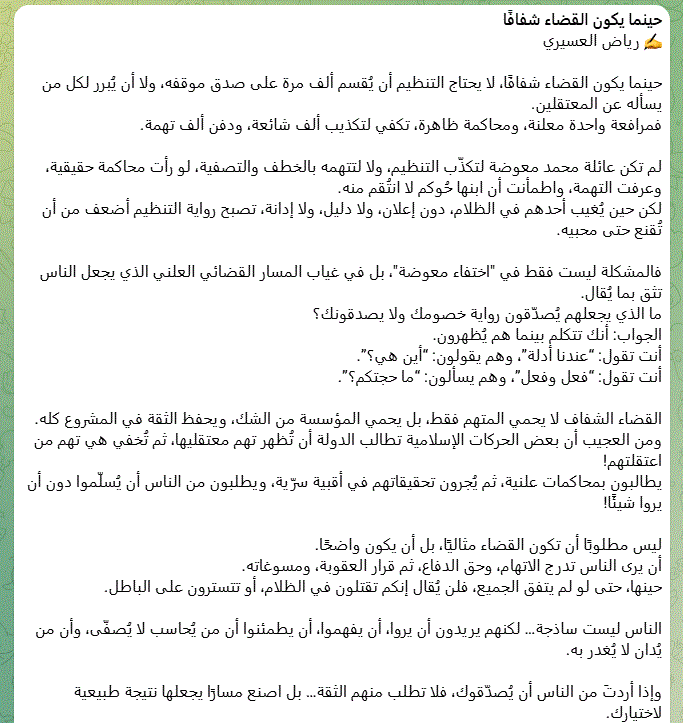
The former AQAP member also criticized the group’s leadership for failing to grasp the political reality on the ground in Yemen, citing its refusal to abandon the al-Qaeda brand as a major obstacle to its success. He held up the example of al-Qaeda’s former Syrian branch, Nusra Front, which rebranded as Hayat Tahrir al-Sham (HTS) and now holds power in parts of Syria.
Al-Asiri’s comments have sparked a significant controversy in jihadist circles, with some experts believing that they may strike a chord with disaffected AQAP members. Various jihadist movement analysts have described al-Asiri as a “dissident commander and leading member” of AQAP, and noted that the group’s leadership had reportedly asked al-Asiri’s son, who is still a member of AQAP, to respond to his father’s criticism.
The criticism comes at a time when AQAP is facing significant challenges, including the loss of senior figures in US airstrikes. The group’s leadership has repeatedly blamed spies on the ground for assisting in these strikes, but al-Asiri’s allegations suggest that the group’s own security failures may be to blame.
Al-Asiri’s defection is not an isolated incident. In 2020, AQAP confirmed internal strife over its handling of the issue of spies within the group. The emergence of the Change and Liberation Movement (Tayyar al-Taghyir wal-Tahrir) earlier this year, which has been portayed as an effort by former al-Qaeda elements to move in a more pragmatic and overtly political direction, also suggests that there are divisions within the jihadist movement.

As AQAP faces these internal challenges, al-Asiri’s criticism serves as a warning to the group’s leadership: adapt to the changing political landscape, or risk being replaced by others at will.
Background
Riyad al-Asiri is a Yemeni national who claims to have joined AQAP after previously being a member of the Muslim Brotherhood and Salafi Jami movement. He says he held a senior position within AQAP, although the exact nature of his role is unclear. Al-Asiri joined X in 2022 and has written on a variety of mainly political subjects, including the ongoing war in Gaza. He launched his Telegram account Nuqtat Taswib (@naseh_ami) on July 12. Al-Asiri adds that he does not currently belong to any group and that “my loyalty is to Islam alone”. He says he also writes poetry and interprets dreams.