
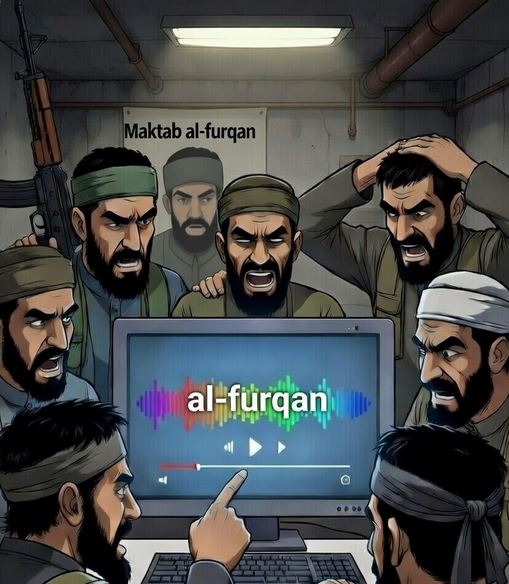
Following an extended period of silence from the IS spokesman, On 26 January 2026, high-profile online supporters of the Islamic State (IS) issued a warning about a fake audio message circulating online, purportedly from the group’s leadership. The message, attributed to al-Furqan, ISIS’s media arm responsible for releasing leadership communications, was swiftly dismissed by key figures in the pro-ISIS online community.
ISIS has not released any official audio message via its Telegram channels since March 2024, leaving its followers reliant on the editorial of its weekly newspaper, al-Naba, for guidance and directives. This absence has fuelled speculation and frustration among supporters, who have been eagerly awaiting a new message from the group’s leadership. This release calls into question, why there has been such a gap in official releases from the spokesman? And why have they been so quiet? ISIS’s silent leadership evidences a caliphate and brand in decline.
A Fake Message and Its Implications
Prominent ISIS supporters, including Abu Layla al-Furat, al-Shayoukhi, Hajji Imad, and Bahith Strategy, took to Facebook to denounce the audio message as a forgery. While they did not share the message publicly to avoid spreading it, they offered to share it privately with trusted individuals. Supporters ridiculed the effort, citing the poor audio quality and the fact that it had not been disseminated through ISIS’s official channels. Some noted that al-Furqan typically announces leadership messages in advance and would not release them “at midnight,” when most of its Middle Eastern audience would be asleep.
Accusations of Foul Play
Some supporters pointed to accounts they had previously flagged as untrustworthy particularly “Abu Muhammad Jabha,” suggesting that intelligence agencies were behind the fake message in an attempt to sow discord and confusion among supporters.
The belief that an intelligence agency is behind the message is likely to further undermine IS confidence in online platforms and cause further fractions amongst an already divided support base.
A Context of Frustration and Disillusionment
The alleged fake message emerged amid reports that ISIS prisoners, especially women held in al-Hol camp in Syria were escaping. It followed ISIS’s relatively underwhelming commentary on 22 January, which initially offered no practical assistance to the detainees and gave no call to action for supporters. In al‑Naba issue 532, dated 29 January, over two weeks later, a disappointing call to action is positioned at the very end of a lengthy IS rebuke against the Syrian government; suggesting that IS felt compelled to comment due to backlash rather than through compassion, sympathy and genuine commitment.
The lack of decisive action has sparked criticism within the pro-ISIS community, with some supporters defending the group against accusations of inaction while others expressed disappointment. The fake audio message only added to the growing frustration, as supporters continue to hope for a leadership message to address their concerns.

A Broader Context of Desperation
The fake audio message comes against the backdrop of occasional expressions of hope among ISIS supporters for a leadership message, given the nearly two-year silence. This desperation underscores the group’s struggle to maintain cohesion and relevance in the face of internal divisions and external pressures.
ISIS’s Silent Leadership: A Caliphate in Crisis
The Islamic State (ISIS) has been shrouded in silence since its last leadership message was released on March 28, 2024, marking the 10th anniversary of its “caliphate” declaration. The audio message, delivered by spokesman Abu Hudhayfa al-Ansari, proclaimed the event as “a turning point in the modern history of Islam” and was titled “By God, it shall be done,” referencing the group’s alleged eventual dominance.
Yet, the so-called “caliph,” Abu Hafs al-Hashimi al-Qurashi, announced in August 2023, remains a faceless figure. Despite widespread media speculation that the current leader is actually Abdulkadir Mumin, head of ISIS’s Somalia branch, Abu Hafs al-Hashimi al-Qurashi is believed to be an alias for Mumin. This anonymity has only deepened the mystery surrounding ISIS’s leadership.

A Caliphate Without a Face
The absence of a public identity for the caliph position has fuelled speculation and frustration among supporters. While ISIS has cited security concerns as the reason for this anonymity, there may be deeper motivations. The lack of a verifiable lineage tied to the Qurayshi tribe, a religious requirement for the caliphate, has become a point of contention. Abandoning this requirement would undermine ISIS’s claims of religious legitimacy, a cornerstone of its ideology.
The Silence of Leadership
The nearly two-year silence since the last leadership message reflects ISIS’s heightened security posture following relentless pressure on its leadership. A consistent trend of airstrikes targeting key figures has forced the group to adopt a more clandestine approach.
However, this silence has come at a cost. Supporters have grown increasingly disillusioned, particularly as ISIS has shifted its focus from the Levant to Africa, as highlighted in recent editions of its weekly newspaper, al-Naba. This shift has alienated many supporters who view the group’s African operations as a distraction from its core mission.
The Fake Audio Message: A Catalyst for Discord
The recent circulation of a fake audio message, attributed to ISIS leadership, has further exacerbated tensions within the pro-ISIS online community. Supporters quickly debunked the message, citing its poor audio quality and lack of official dissemination. Some speculated that intelligence agencies were behind the effort, aiming to sow discord among supporters.
This incident underscores the group’s struggle to maintain control over its narrative. With no genuine leadership message in sight, supporters are left grappling with uncertainty and frustration, further eroding ISIS’s already fragile cohesion.
A Caliphate in Decline
ISIS’s silent leadership and shifting focus have left the group in a precarious position. The absence of a verifiable caliph, coupled with its inability to inspire meaningful action, has weakened its appeal. The fake audio message serves as a stark reminder of the group’s vulnerability and the challenges it faces in maintaining relevance.
ISIS’s inability to issue a genuine leadership message has left its supporters disillusioned and divided. The fake audio message, while debunked by key figures, highlights the group’s struggle to maintain its narrative in the face of internal dissent and external scrutiny. It also further highlights the lack of confidence in the integrity of IS online spaces, which is causing rifts amongst its supporters.
As ISIS continues to grapple with internal divisions and external pressures, its once-feared caliphate is increasingly seen as a shadow of its former self. The silence of its leadership is not just a strategic move, it is a symptom of a group struggling to survive in an increasingly hostile world.